Work · AstroTalent
There are about eleven people in North America who can fill that seat.
An intelligence platform for a market where the number did not exist.
- companies, read every morning
- 94 companies, read every morning
- positions in the scarcity taxonomy
- 53 positions in the scarcity taxonomy
- proprietary numbers on any public page
- 0 proprietary numbers on any public page
In plain terms: ninety-four companies are read every morning, so when a client asks how few people could actually fill a seat, the answer comes back the same day instead of as a guess.
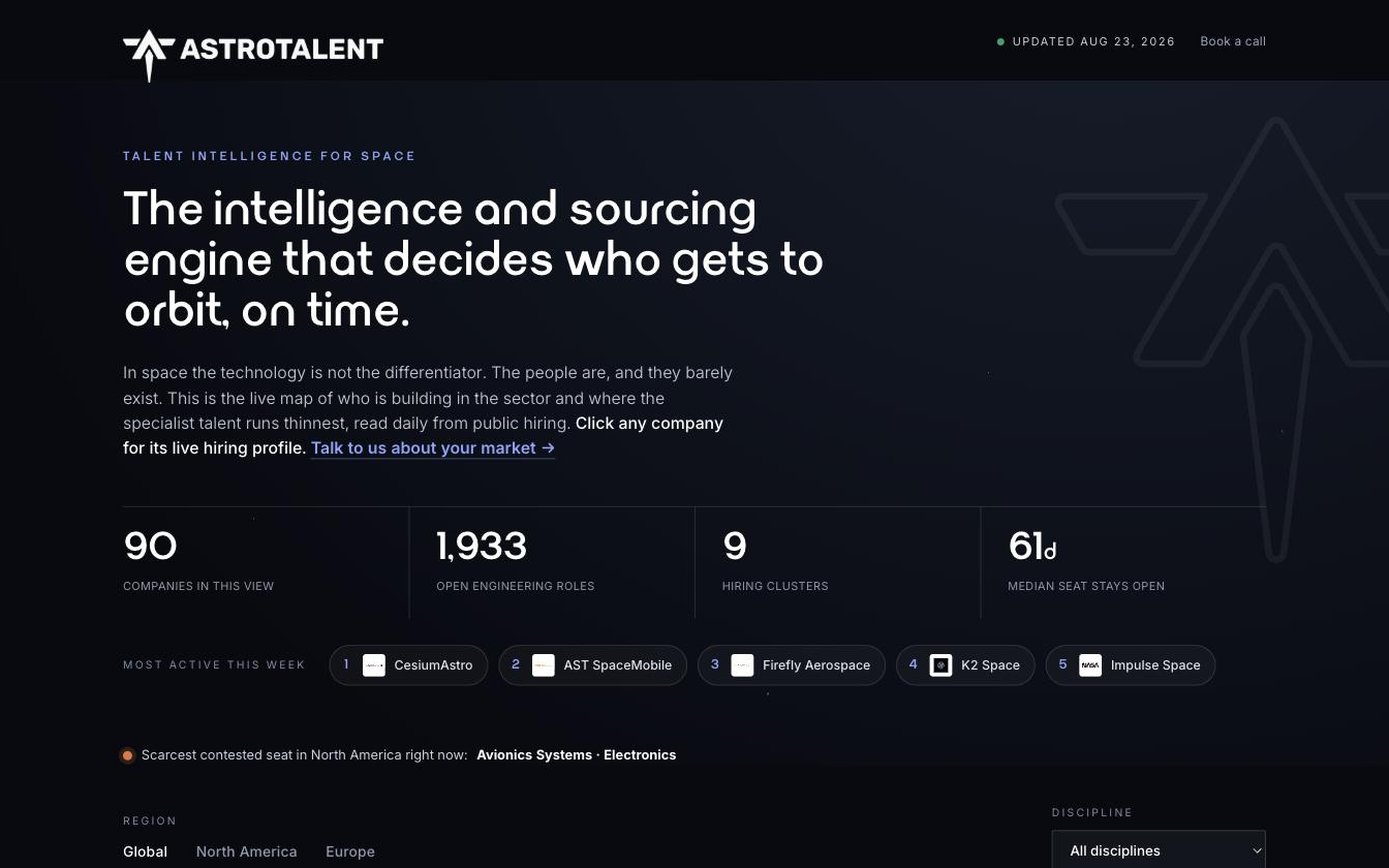 intel.astrotalent.com
 Three months in, and the machine is running. Ninety-four company boards read every morning, an intelligence layer nobody else in this market has, and a named-account programme live off the back of it. That is what this page is about.
The situation. Space has a real talent shortage, and AstroTalent is a specialist search firm working inside it, placing engineers into space companies: Kepler, Tomorrow.io, a VP of Logistics Products at Gravitics for a $250m Axiom contract. The firm knows this market better than anyone we have worked with. What it did not have was a way to prove that knowledge to somebody who had not met them yet.
What was missing was not a website. It was a number. When a company says it needs a GNC engineer, the useful question is how many people could actually do that job, and where they already work. Nobody could answer it, because nobody was holding the data that would let them. Not the ATS vendors, not the job aggregators, not LinkedIn. The number simply did not exist in a form you could put in front of a founder.
Where it started, which was not with a website. It started with outbound. To write to a named company about its hiring, you have to know its hiring, in detail, this week. So we began by reading each company’s job board API live.
That works for about a day. A live API tells you what is open right now and nothing at all about what has been open for four hundred days, which is the thing you actually want to know. So we stopped reading and started keeping. Every role, from every board, every morning, kept.
What keeping it unlocked.
- History. Once you hold yesterday’s copy you can compute days open. The median time a tracked engineering role stays open is 73.5 days. A role coming down is not proof of a hire, so open is the word the page uses. The long tail, the seats sitting past a thousand days, cleanly isolates the roles a company has quietly stopped trying to fill through its own board. Those are precisely the seats worth a phone call, and they are invisible if you only ever look at today
- Coverage. 91 job boards across 12 different applicant systems, from the clean public APIs through to the ones that had to be taken apart by hand. Region aware, primes tracked but held out of the comparison so the story stays startup against startup
- Classification. Every role tagged by discipline the morning it appears
Then the part that makes it worth something. A proprietary taxonomy: function, then family, then position. 53 positions, each carrying its own North American talent pool, with a classifier that maps any live job title onto a sized position and reads seniority out of the title. So “Director, Propulsion Engineering” does not come back as propulsion. It comes back as near-impossible, computed from live demand against real supply rather than asserted by somebody with an opinion.
That is what lets a page say only about eleven people in North America can fill your seat, and mean it.
The discipline that made it safe to publish. The pool model is the entire asset, so it never touches the browser. It is kept out of the repository, read at build time from a private sheet, and rendered as qualitative scarcity bands on anything public. The real figures appear only on the gated pages, for the company they belong to. Every build runs a leak check across every generated file, and it has to come back at zero.
That is not a setting somebody switched on. It is the difference between owning a dataset and giving it away one page view at a time, and it was decided before a single page was designed.
Flight Proven Space, which is a by-product. Having built a clean daily copy of every space engineering role in the market, leaving it sitting in a database felt like a waste. So it became a public job board: 94 companies, 2,414 open roles, 139 internships, read from each employer’s own careers site every morning at 06:00 UTC. The site says what that means: when a role closes there it disappears here, and when it says open, it was open this morning.
The early-career view is the quiet opportunity in it. 57 graduate and entry-level roles pulled out of the whole market, with salary shown wherever the employer disclosed it. Nobody aggregates space graduate roles, which makes that the cheapest audience on the board to reach and the one most likely to still be there in ten years.
Underneath it is more careful than it looks. Search is split the way a travel site splits it, keywords in one box and a real place in the other, over a location vocabulary rebuilt from the live data on every load. Raw board locations are messy, so 188 different location strings resolve down to 149 real places, and anything that will not parse keeps its raw label rather than being dropped. Every role page carries JobPosting structured data. Closed roles become tombstones and leave the sitemap the same day.
It is live and not yet promoted, for two ordinary reasons. Where it finally lives is still open, because a by-product this good may deserve its own home rather than staying where it was built, and there is a round of speed work to finish first. Neither is a reason to push it at an audience this week.
What is running now. The platform rebuilds itself every morning. The named-account programme is live alongside it: custom pages built for individual companies, each showing that company its own slice of the data, and posts going out pointing at them, QR codes included, so somebody can scan and land on a page about their own hiring. The figures behind those pages stay off this one.
Their website is the next build.
There is no enquiry number here yet. When there is one it will be counted rather than estimated.
More of it
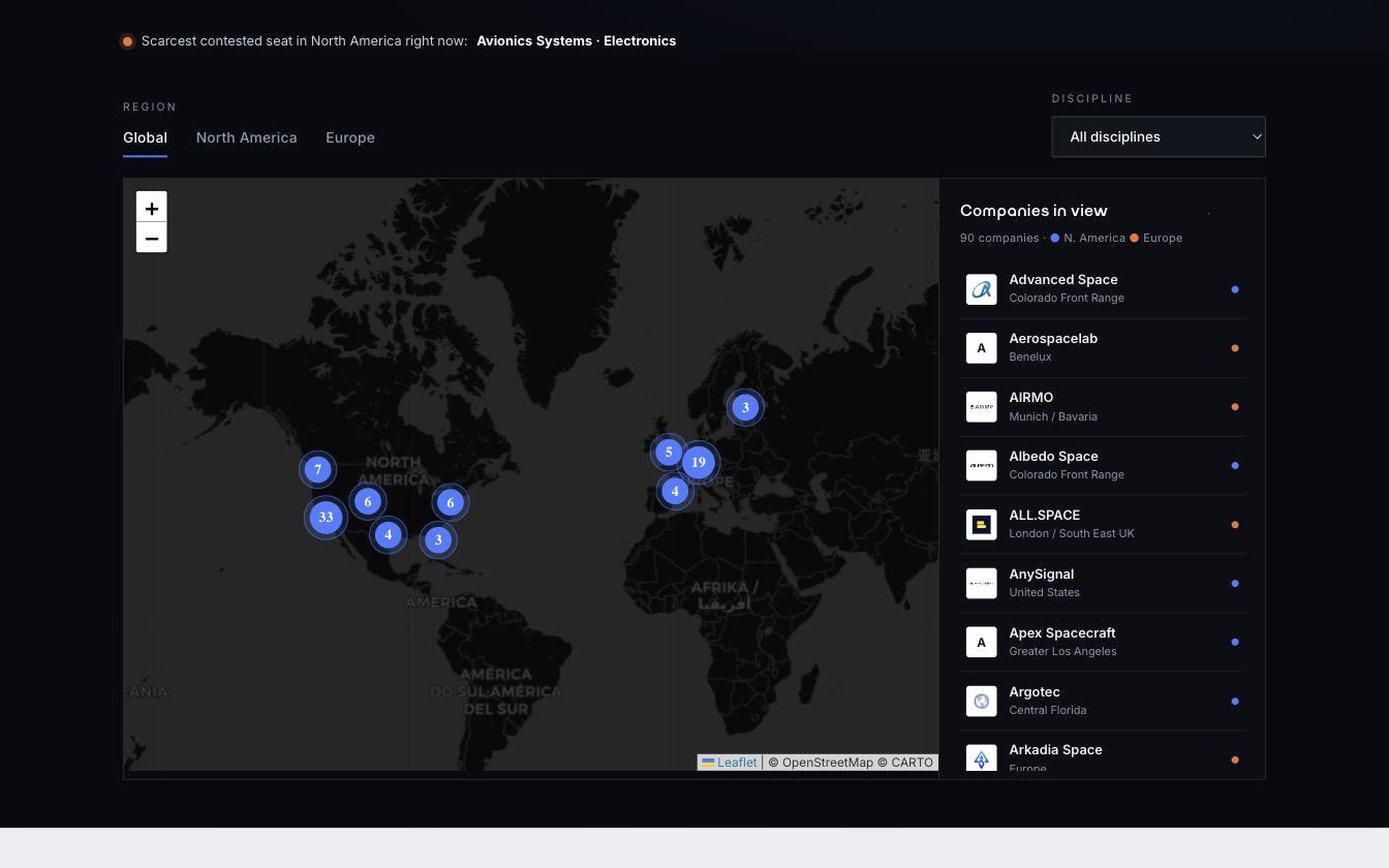 intel.astrotalent.com
 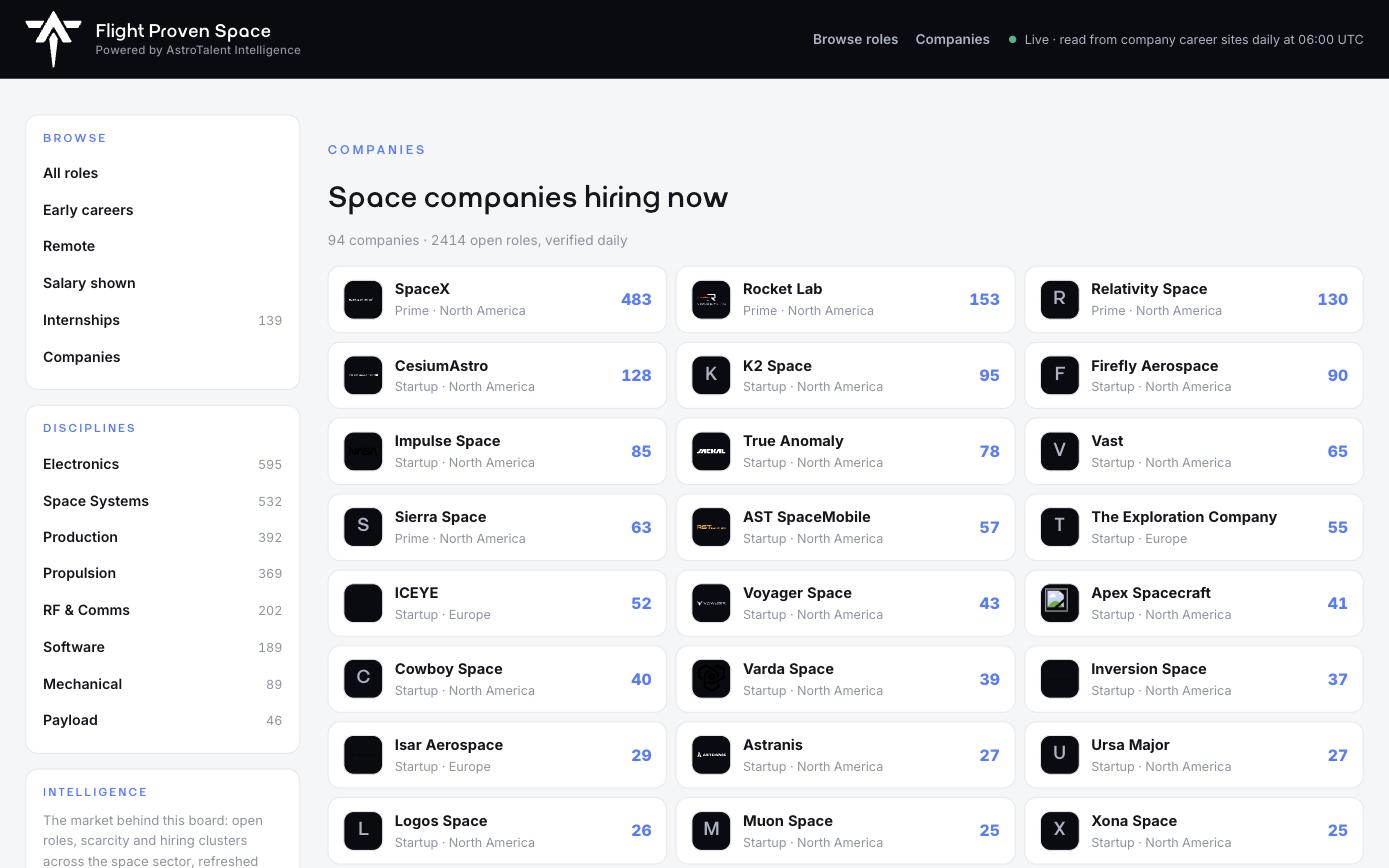 flightproven.space/companies
 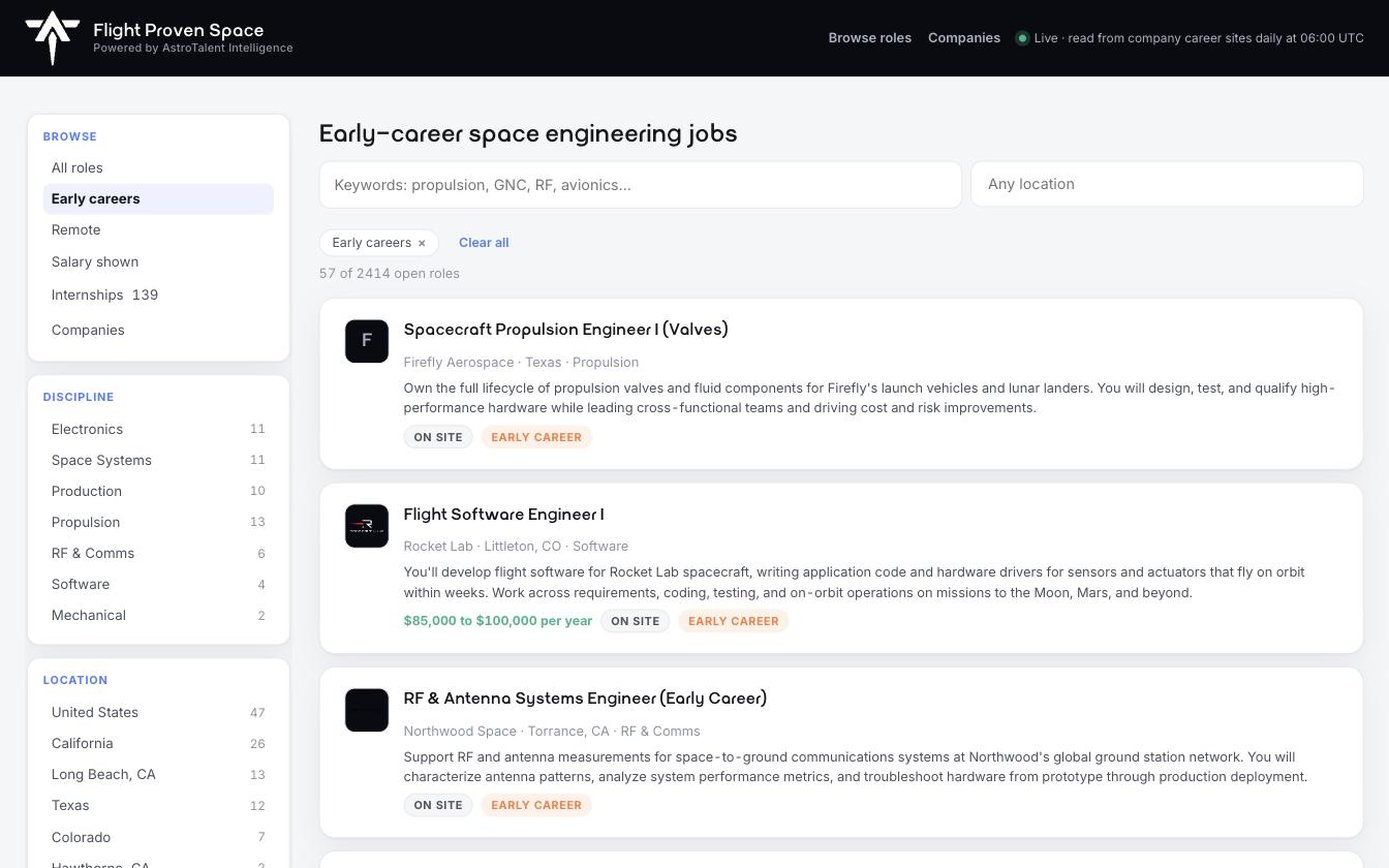 flightproven.space/jobs?early=1
 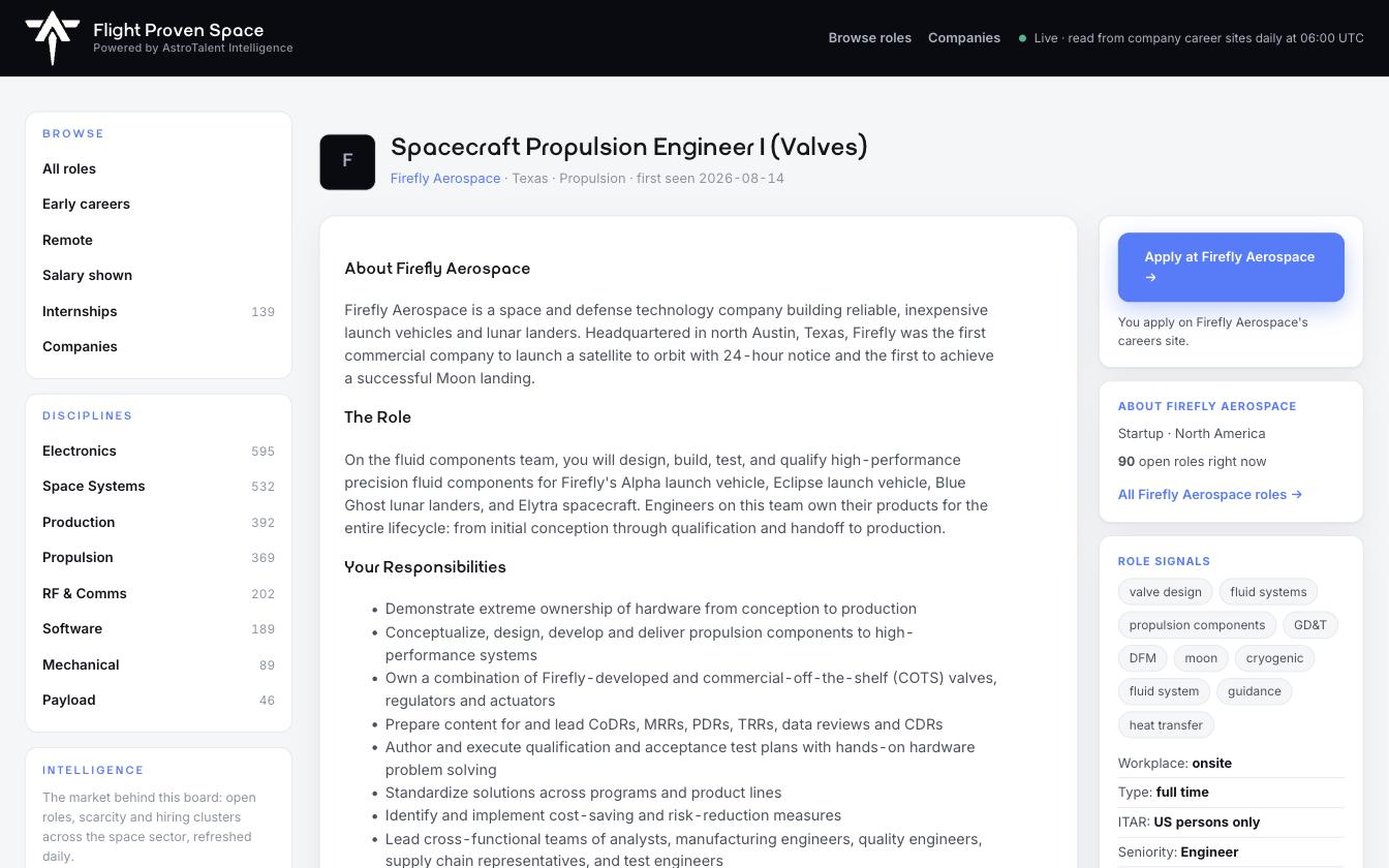 One role, in full
 What this was, in components
- Data Platform
- Outbound Sprint
- Estate Expansion
Everything we sell is priced as a component, so a build like this one is assembled rather than quoted as a lump. See what each of those costs →
The palette
-
#090a0fintel ground -
#5a7dffindigo -
#ffffffopen tier
Two grounds on purpose. The public board is white and fast; the intelligence platform is near-black, so the gated side feels like a different room, because it is.